
Artificial Intelligence is rapidly changing how the world works—from education and healthcare to agriculture, manufacturing, finance and governance. For a country as diverse and digitally connected as India, AI presents both a major opportunity and a significant responsibility.
To build a strong domestic AI ecosystem, the Government of India approved the IndiaAI Mission in March 2024, with a financial outlay of ₹10,371.92 crore over five years. The mission is built around the vision of “Making AI in India and Making AI Work for India.” (Press Information Bureau)
Rather than focusing only on developing AI models, the mission takes a broader approach—covering computing infrastructure, datasets, AI research, applications, skills, startups and responsible AI.
What Is the IndiaAI Mission?
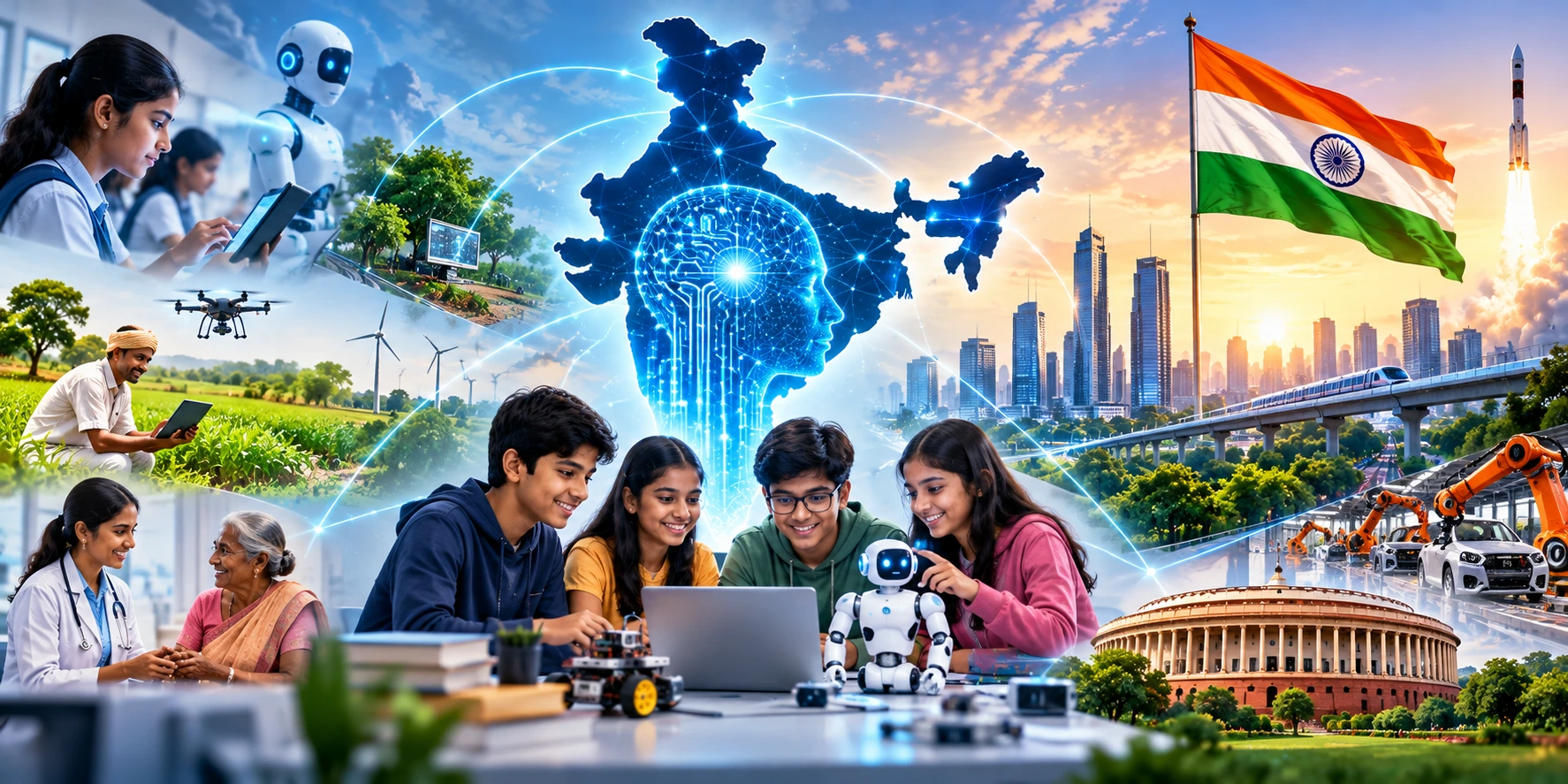
The IndiaAI Mission is a national initiative designed to strengthen India's AI capabilities and make AI innovation more accessible to researchers, startups, businesses and institutions.
The mission is being implemented through IndiaAI, an Independent Business Division under Digital India Corporation and the Ministry of Electronics & Information Technology (MeitY). (Press Information Bureau)
Its objective is not simply to adopt AI developed elsewhere, but to build capabilities that allow India to develop, deploy and responsibly use AI for Indian requirements.
This includes developing AI models using Indian datasets and languages, making computing resources accessible, encouraging AI entrepreneurship, developing skilled professionals and creating solutions for sectors that directly affect citizens.
The Seven Pillars of IndiaAI Mission
The IndiaAI Mission is structured around seven major pillars.
1. IndiaAI Compute
AI development requires significant computing power, particularly GPUs for training and running advanced models.
The IndiaAI Compute pillar aims to create a scalable AI computing ecosystem and make high-end computing resources accessible to startups, researchers and innovators. The original mission target was more than 10,000 GPUs, while government updates in 2026 reported that the national compute capacity had expanded to 38,000 GPUs. (Press Information Bureau)
This infrastructure can help reduce one of the major barriers faced by smaller AI companies and research institutions: access to expensive computing resources.
2. IndiaAI Innovation Centre
Building India's own AI capabilities is another important component of the mission.
The IndiaAI Innovation Centre focuses on developing indigenous foundational and large multimodal AI models, including models designed around Indian datasets, languages and requirements. (Press Information Bureau)
This is particularly important for India because the country's linguistic and social diversity creates requirements that may not always be adequately addressed by globally developed AI systems.
Indian-language AI can potentially support applications across education, government services, agriculture, healthcare and other areas where language accessibility is essential.
3. IndiaAI Datasets Platform — AIKosh
AI systems depend heavily on data.
The IndiaAI Datasets Platform, now associated with AIKosh, is intended to make high-quality datasets, models and related resources more accessible to AI developers and researchers.
Government information published in 2026 reported that AIKosh had expanded to thousands of datasets and hundreds of AI models across multiple sectors. (Press Information Bureau)
Better access to relevant datasets can help innovators spend more time building useful AI applications instead of repeatedly creating basic data infrastructure.
4. IndiaAI Application Development Initiative
AI becomes meaningful when it solves real problems.
The Application Development Initiative focuses on developing and scaling AI applications for important sectors and challenges identified by government ministries, state departments and other institutions. (Press Information Bureau)
Potential application areas include:
Healthcare
Agriculture
Education
Climate and environment
Governance
Accessibility and assistive technologies
Cybersecurity
This approach shifts the conversation from “How powerful is the AI?” to “What problem can AI solve?”
For India, this distinction is particularly important because AI can be applied to challenges affecting large and diverse populations.
5. IndiaAI FutureSkills
Technology infrastructure alone cannot create an AI-powered economy. People need the skills to build and use that technology.
The IndiaAI FutureSkills pillar focuses on increasing access to AI education at undergraduate, postgraduate and doctoral levels. It also includes the development of Data and AI Labs in Tier 2 and Tier 3 cities. (Press Information Bureau)
This has an important implication for education.
AI education cannot remain limited to a small group of computer science students. Students need opportunities to understand:
AI → Data → Coding → Computational Thinking → Responsible Technology
Schools, colleges and training institutions can therefore play an important role in creating the next generation of AI users, developers, researchers and entrepreneurs.
6. IndiaAI Startup Financing
India has a growing startup ecosystem, but advanced AI development can require substantial investment in research, computing infrastructure, talent and product development.
The IndiaAI Startup Financing pillar is designed to support deep-tech AI startups and improve their access to funding. (Press Information Bureau)
This can help create an environment where Indian startups can experiment with new AI models and applications and take them from research and prototypes toward real-world deployment.
The larger objective is to encourage innovation within India rather than relying entirely on technologies developed outside the country.
7. Safe & Trusted AI
AI brings opportunities, but it also introduces challenges involving misinformation, bias, privacy, security and reliability.
The Safe & Trusted AI pillar focuses on responsible AI development through tools, frameworks, guidelines, risk-management approaches and other mechanisms designed to encourage trustworthy AI adoption. (Press Information Bureau)
Recent initiatives under this pillar have included work related to responsible AI, stress testing, risk assessment and deepfake detection. (Press Information Bureau)
This reflects an important principle:
AI innovation and AI responsibility need to develop together.
Why Is the IndiaAI Mission Important?
The significance of the mission goes beyond government programmes.
It can influence several layers of India's technology ecosystem.
For Students
Students will increasingly need more than traditional computer literacy.
Understanding AI, coding, data, robotics and computational thinking can help students become creators rather than simply consumers of technology.
For Schools
Schools can begin preparing students for an AI-driven economy through practical exposure to:
AI concepts
Coding
Robotics
Data literacy
Computational thinking
Problem-solving
Responsible technology use
The objective should not be to make every student an AI engineer. Instead, students should understand how AI works, where it can be used and how to use it responsibly.
For Startups
Affordable access to computing resources, datasets, funding and research opportunities can reduce some of the barriers associated with AI innovation.
For Businesses
AI can support automation, customer service, analytics, decision support, content generation and process optimisation.
Businesses will increasingly need to think about not only adopting AI tools but also developing an AI-ready workforce.
For Society
India's AI strategy has a strong focus on applications that can address large-scale social and economic challenges.
For example, government initiatives are already supporting AI applications in areas such as healthcare, including projects under the IndiaAI–National Cancer Grid Cancer AI & Technology Challenge. (Press Information Bureau)
From “Using AI” to “Building AI”
One of the most important aspects of the IndiaAI Mission is the shift from simply consuming AI technologies to developing India's own capabilities.
This involves several layers:
Compute → Data → Models → Applications → Skills → Startups → Responsible AI
Each layer supports the others.
Better computing infrastructure supports research.
Better datasets support better models.
Better models enable new applications.
Applications create demand for skilled professionals.
Skilled professionals contribute to startups and research.
And responsible AI frameworks help ensure that these technologies are deployed safely.
This creates an ecosystem rather than a single AI programme.
What Does the Future Look Like?
India's AI journey is still developing.
The IndiaAI Mission provides a national framework for building infrastructure, talent, research capabilities and applications around AI. Government updates indicate that the mission has already expanded beyond its initial computing target, while initiatives around indigenous models, AI datasets, skills and responsible AI continue to develop. (Press Information Bureau)
The larger question is no longer whether AI will become important for India.
The question is how effectively India can develop AI that addresses its own languages, industries, communities and challenges.
From classrooms to startups, laboratories to government services, the next phase of India's digital transformation will increasingly involve artificial intelligence.
And the IndiaAI Mission represents one of the country's major efforts to build the infrastructure, talent and ecosystem required for that transformation.
The IndiaAI Mission is more than an AI development programme. It represents an ecosystem-building approach that connects computing power, data, research, education, startups, applications and responsible AI.
For students, it highlights the growing importance of AI and future-ready skills. For educators, it creates an opportunity to rethink how technology is taught. For startups and researchers, it aims to create greater access to resources. And for society, it opens the possibility of applying AI to some of India's most complex challenges.
India's AI future will ultimately depend not only on how advanced its technology becomes, but also on how effectively that technology is made accessible, useful and responsible for people across the country.
IndiaAI's core idea captures this direction clearly: “Making AI in India and Making AI Work for India.”